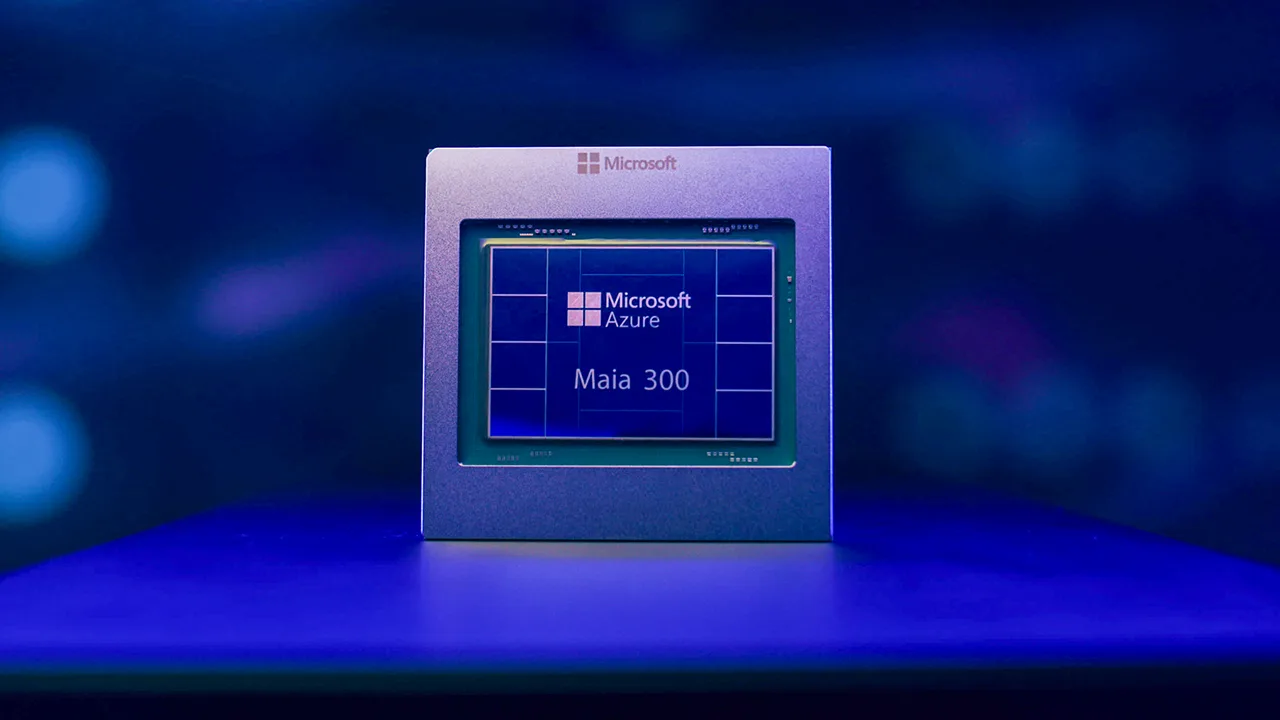
Microsoft has unveiled its third-generation Maia AI chip, and it is already saying this one will become the main engine behind its AI services. The last one, Maia 200, was only announced in January.
Maia 300 is the successor to that chip. Microsoft wants it to be the primary AI inference system for its products and services. Inference just means running a trained model to answer requests. Scott Guthrie, who leads Microsoft's cloud group, laid out the plan in a blog post. Microsoft will scale the Azure Maia family to multi-gigawatt deployments starting in 2027.
For a company that has leaned on Nvidia's GPUs for years, that is a big statement. Microsoft introduced its first AI chip, Maia 100, in 2023. Three generations later, it is describing its own silicon as the default.
Seven times the throughput, by Microsoft's count
The headline number is about efficiency. Microsoft expects Maia 300 to deliver 40% more tokens per megawatt than leading GPU-based systems. Tokens are the chunks of text a model reads and writes, so this is a measure of how much AI output the company gets from each unit of power.
There is also a jump over the previous generation. In a full 96-accelerator configuration, Maia 300 delivers up to 7x the rack-scale token throughput of Maia 200. Microsoft expects to fit 96 Maia 300 chips in each data center rack, double the number for Maia 200. All of these figures are Microsoft's own claims and projections.
Under the hood, Microsoft is using a chiplet design built on TSMC's N2P process. It splits compute, memory controller and I/O into separate pieces. The Azure hardware and infrastructure team says this gives more silicon area to compute and lets each function use the technology that suits it best.
Microsoft says the chip is built for the workloads now taking over. The blog post calls Maia 300 a "complete intelligent system" for long-context reasoning, latency-sensitive conversation and long, multi-step agentic tasks.
Not here until 2027
None of this runs in production yet. Maia 300 starts handling production workloads in 2027, and Microsoft hasn't said when the multi-gigawatt build-out will be done. Alistair Speirs, a Microsoft general manager, declined to give a timeline. He said Microsoft will "reserve a little bit of optionality" because the industry is changing so fast.