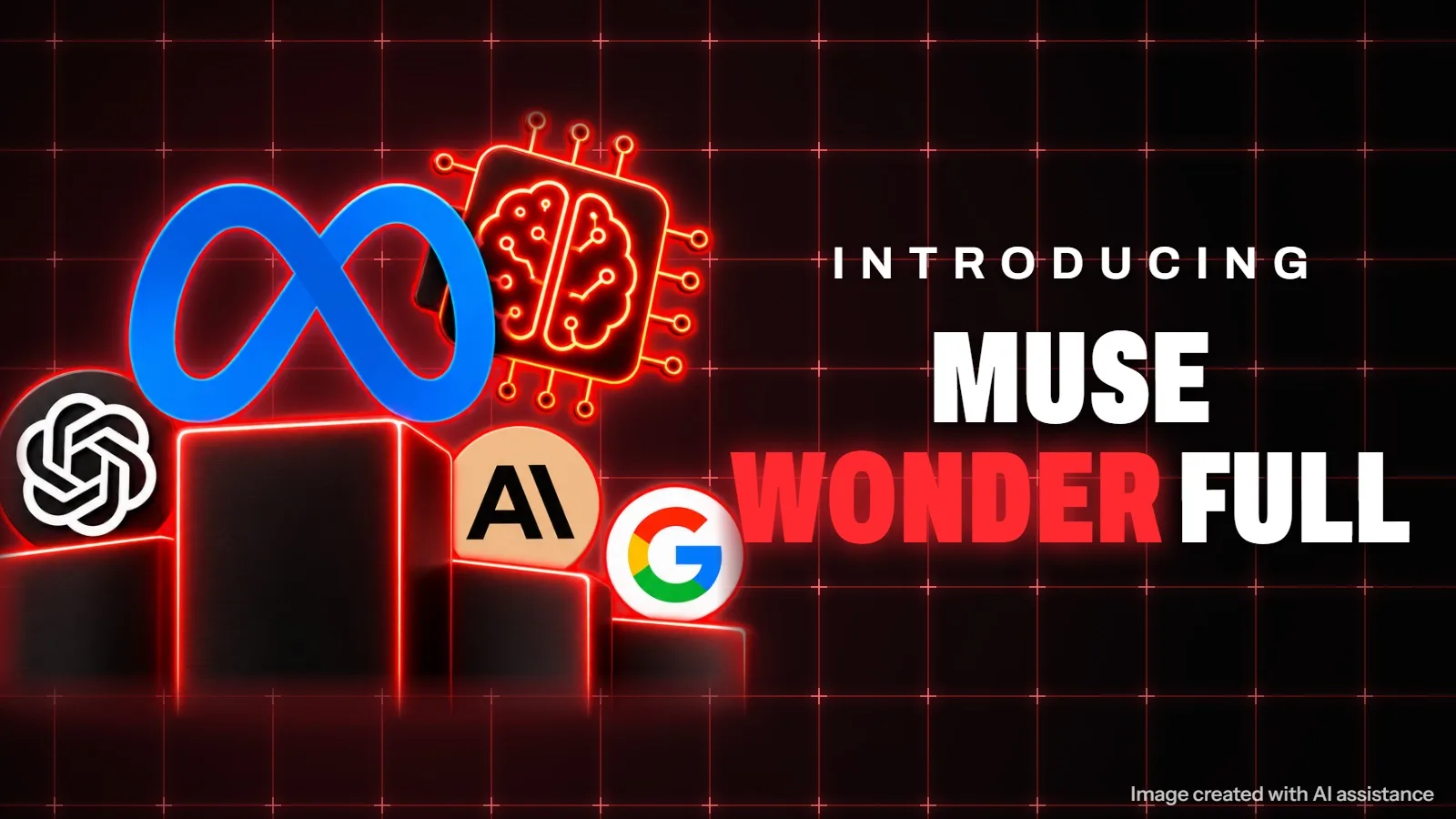
Fourteen months ago, Meta says, it started tearing up its AI effort and rebuilding it. Now it claims the result can stand next to the best models from OpenAI and Anthropic.
The models are Muse Wonder and Muse Wonder Full, which Meta calls its most capable yet. They build on Muse Spark and are aimed at agent work, meaning tasks a model carries out for you instead of just answering questions. Meta's examples include navigating an insurance claim, understanding a lease and making sense of someone's finances. It also points to law, finance, health and coding.
Two features built for long jobs
Meta's pitch rests on two named features. Active Memory carries what matters to you across conversations and brings back relevant details when a task needs them. Active Focus keeps the model working when a task gets hard: it tries other approaches, recovers from errors, asks for clarification when needed and checks in before doing anything important.
That matters because Meta wants the model to handle your messages, calendars and documents. The company says it trained the models not to share private information without permission and to turn down requests to help with harmful acts. It also says they can still help developers and security teams find flaws in their own code. A full report with more safety evaluations is promised "soon."
The Verge's recent Muse coverage includes a report that the Muse agent sent a YouTuber's address to a stranger. That is a reminder of what is at stake with this kind of access.
What the independent scoreboard says
Meta's own claim is that the models rival GPT-6 Astra, Claude Opus 5.5 and Claude Fable 5.1, based on internal testing on industry benchmarks.
Outside testing is a bit more modest. Artificial Analysis gave Wonder Full a 56 on its Intelligence Index, tying Claude Sonnet 5.5 and beating GPT-6 Astra, Gemini 4 Argon and Claude Fable 5.1, which each scored 53. Only Claude Opus 5.5, at 58, scored higher. Standard Muse Wonder scored 52, while Muse Spark 1.3 sat at 48.
The biggest gains are in agentic tests. On Terminal-Bench 4.0, performance jumped from 33 to 57 percent. On ProofBench, a private math-proof benchmark, Wonder Full solves 94 of 100 problems, up from 58 for its predecessor. On SWE-Marathon, it scores 57.5 against 46.3 for Opus 5.5 and 42.5 for GPT-6 Astra.